
After-Hours Real Estate Leads: 26% Conversion in 60 Seconds
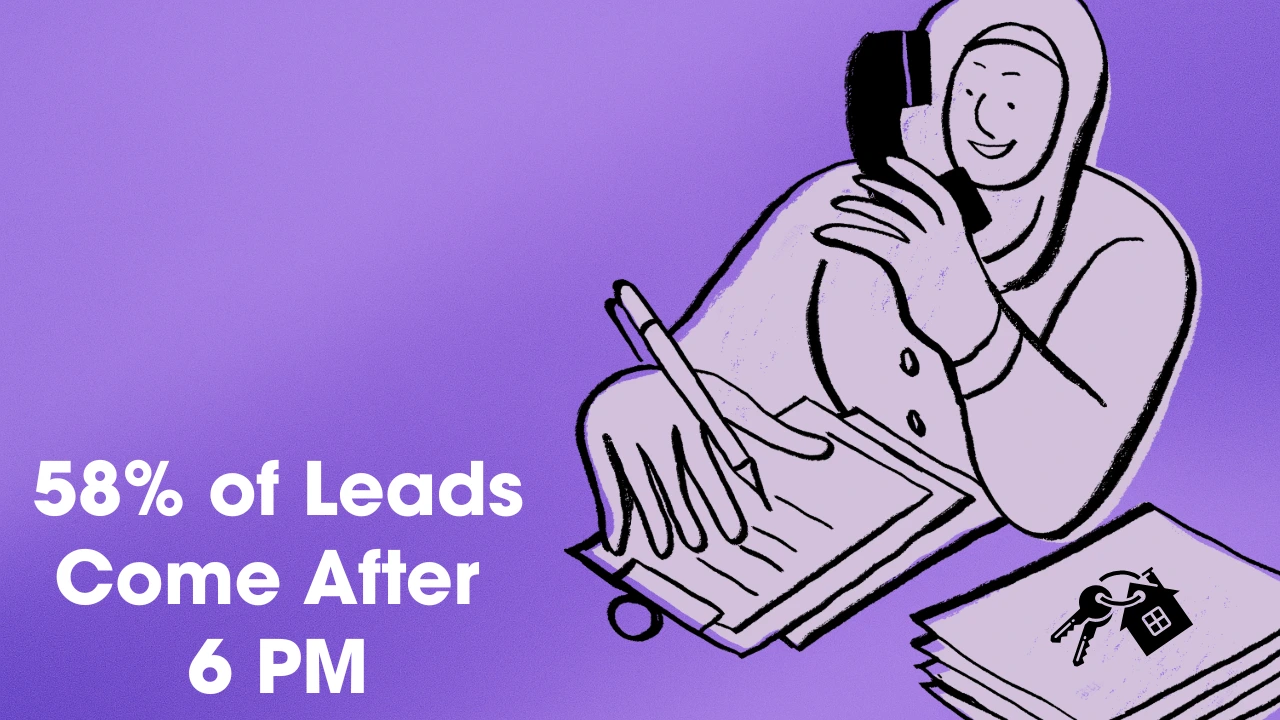
After-hours real estate leads convert at 26.1% when contacted within 60 seconds, yet brokerages respond in 14.2 hours. Discover how AI ISAs capture the 58.4% of leads arriving after hours.
After-hours lead capture: why 40% of real estate inquiries happen outside business hours
Table of Contents
Why After-Hours Leads Are Actually Higher Intent (The Counterintuitive Truth)
Conclusion: After-Hours Leads Are Your Highest-ROI Asset—If You Capture Them
Key Takeaways
After-hours real estate leads account for 58.4% of total inbound volume but generate only 22% of booked appointments under traditional staffing models
Leads contacted within 60 seconds convert at 26.1%—yet the median brokerage response time is 14.2 hours
AI ISAs respond 19.7x faster than human teams, making sub-60-second after-hours response operationally achievable
After-hours inquiries are higher-intent assets, not low-priority overflow—treating them otherwise is the most expensive mistake in your pipeline
Introduction: The $0 Lead You're Already Paying For
According to AgentZap, 62% of real estate inquiries arrive outside business hours. Brokerages spend thousands per month on Zillow leads, paid search, and IDX traffic—then structurally forfeit the majority of what that spend generates, because no one picks up the phone at 9pm on a Sunday.
This is not a staffing inconvenience. It is a revenue leak built into the operating model.
This article makes three arguments. First, the conversion data shows that after-hours leads are not lower quality—they are actually higher-intent than daytime inquiries when response is fast enough to capture them. Second, traditional staffing models are architecturally incapable of serving this segment; the math simply doesn't work. Third, AI-powered response closes the gap at scale, without adding headcount. If your brokerage is paying for lead generation, you are already paying for these leads. The question is whether you are collecting on them.
The After-Hours Lead Volume Problem: More Than You Think
After-hours real estate leads are not an edge case—they are the majority of what your pipeline receives. According to SwiftLeads AI, 58.4% of total inbound lead volume arrives outside standard business hours. A separate analysis from AgentZap puts the figure at 62%. Two independent data sources pointing to the same structural reality: most of your leads come in when your team is offline.
The reason is straightforward consumer behavior. Buyers browse Zillow, Realtor.com, and brokerage IDX portals during evenings and weekends—when they are off work, sitting on the couch, and have the mental space to think about a home purchase. The inquiry moment is dictated by the buyer's schedule, not the brokerage's office hours. That is never going to change.
What makes this a critical business problem is what happens next. Despite representing 58.4% of inbound volume, after-hours leads generate only 22% of booked appointments under traditional staffing models, per SwiftLeads AI data. The volume is there. The conversions are not.
The arithmetic makes the revenue leakage concrete. A brokerage receiving 100 leads per week sees roughly 58 arrive after hours. Under a traditional staffing model, only about 13 of those 58 result in booked appointments—a 22% conversion rate applied to the after-hours segment. The other 45 leads expire in a CRM, waiting for a follow-up call that arrives 14 hours too late.
That gap—58 leads received, 13 appointments booked—is not a marketing problem. It is a response infrastructure problem. And it repeats every single week.
Why After-Hours Leads Are Actually Higher Intent (The Counterintuitive Truth)
That 45-lead weekly gap isn't explained by lead quality. It's explained by a widespread and expensive misconception: that after-hours inquiries are lower priority, lower intent, and therefore acceptable to address the following morning.
The behavioral reality is the opposite. A prospect submitting a property inquiry at 10pm on a Tuesday has made a deliberate choice. They've carved out personal time—after work, after dinner, after the kids are in bed—to take action on one of the largest financial decisions of their life. That's not casual browsing. That's active motivation, and it's one of the strongest intent signals a lead can send.
The conversion data confirms it. According to SwiftLeads AI, after-hours leads contacted within 60 seconds convert at 26.1%—a rate that is 11.5 percentage points higher than the daytime conversion baseline. The leads aren't the problem. The response infrastructure is.
What erodes that intent is time. Every hour without contact triggers what practitioners call "intent decay"—the gradual cooling of motivation as the prospect moves on, gets distracted, or hears from a competitor who did respond. With the median brokerage response time sitting at 14.2 hours (SwiftLeads AI), the average after-hours lead is reached the next business day at best. By then, the 26.1% conversion window has long closed.
The 14.2-hour median response time isn't a minor inefficiency—it's a structural conversion killer applied to the majority of your inbound pipeline.
The strategic reframe is straightforward: after-hours leads are not a burden to manage around. They are the highest-intent, most underserved segment in your pipeline—and a genuine competitive advantage for any team willing to respond faster than the industry average.
The Speed-to-Lead Gap: Where Deals Are Won and Lost
Speed-to-lead is the single most important conversion variable for after-hours leads—more consequential than lead source, price point, or agent skill. The data from SwiftLeads AI makes this concrete: contact a lead within 60 seconds and you convert at 26.1%. Let that same lead sit for 14.2 hours—the industry median—and you're not competing for that deal anymore. You're just calling to confirm someone else got there first.
The performance difference between these two scenarios is stark. A 60-second response versus a 14.2-hour response represents a fundamental shift in outcome—one captures the prospect at peak intent, the other reaches them after the moment has passed. That's not a marginal difference in process efficiency. It's the difference between a live conversation with a motivated buyer and a voicemail left for someone who's already toured a property with another agent.
AI ISAs close that gap in a way human teams structurally cannot. According to SwiftLeads AI, AI-powered ISAs respond 19.7x faster than their human counterparts—enabling consistent sub-60-second callbacks at any hour, on any day, without scheduling constraints or overtime costs. A human ISA working a 9-to-5 shift cannot respond at 11pm on a Friday. An AI ISA doesn't know what Friday night means.
The downstream math is unforgiving. A brokerage operating on a 14.2-hour response model generates a 22% appointment booking rate from its after-hours leads, according to SwiftLeads AI. The speed advantage of instant AI response directly addresses this gap—not through better scripts or more persuasive agents, but simply by being present when intent is at its peak.
Every week a brokerage waits to address its response infrastructure is another week of after-hours leads entering a pipeline that systematically forfeits them. The speed gap isn't a technology problem. It's a revenue problem with a measurable price tag.
Traditional Staffing vs. AI ISAs: The Operational Reality
The case for AI ISAs isn't theoretical—it's a direct performance comparison against the model most brokerages currently run. Evaluated side by side, the gap is significant.
Traditional ISA model: Human agents cover defined business hours. After-hours leads queue overnight and receive a median response of 14.2 hours (SwiftLeads AI). Even with a dedicated ISA team, appointment booking from after-hours volume holds at roughly 22% (SwiftLeads AI). Add salary, benefits, training, and turnover costs—ISA attrition in real estate runs high—and the cost-per-appointment figure climbs fast. The model also introduces consistency risk: agent quality varies, scripts drift, and no human team maintains peak performance across every shift.
AI ISA model: 24/7 availability with no shift gaps. Sub-60-second response to every inbound lead, regardless of when it arrives. AI ISAs respond 19.7x faster than human counterparts (SwiftLeads AI) and deliver consistent qualification quality at scale, with no incremental cost per lead contacted.
Kyzo AI's Speed-to-Lead Suite and AI Voice Agents operationalize this model directly. Every inbound lead triggers an automated callback in under two minutes—at 2pm or 2am—without adding a single headcount. The common concern about AI sounding robotic is legitimate for older systems, but Kyzo's voice agents maintain natural conversational quality that keeps prospects engaged through qualification rather than prompting hang-ups.
The ROI framing matters here. The cost of missed after-hours leads—expressed in lost GCI across 45 unbooked appointments per week—almost always exceeds the cost of AI implementation. This is a revenue recovery decision, not a technology expense. When a call goes unanswered, Kyzo's multi-channel fallback (SMS, WhatsApp, and email) continues working the lead across every available channel until contact is made. No lead exits the pipeline simply because a phone went to voicemail.
For brokerages evaluating this shift, the question isn't whether AI ISAs outperform traditional staffing on after-hours response. The data settles that. The question is how much pipeline they can afford to keep forfeiting while they decide.
Implementing a 24/7 After-Hours Lead Capture System
That multi-channel approach only works when the underlying system is built to execute without human oversight. Here is how an effective after-hours capture operation actually runs, mapped to the four stages any brokerage can evaluate against their current workflow.
Step 1 — Instant callback trigger. Every inbound lead, regardless of the hour, triggers an AI voice call within 60 to 120 seconds through Kyzo's Speed-to-Lead Suite. There is no queue, no morning batch, and no dependency on an agent being awake. The moment a prospect submits a form on Zillow, Realtor.com, or an IDX portal, the system responds.
Step 2 — Qualification and routing. During the call, Kyzo's AI ISA qualifies intent through a natural conversation — asking about timeline, property preferences, financing status, and urgency. Leads are categorized through Kyzo's Lead Rating System as interested, neutral, or not interested. High-intent prospects are flagged for priority routing to agents the moment business hours resume, complete with full call context.
Step 3 — Multi-channel fallback. If the initial call goes unanswered, the system doesn't stop. Automated SMS, WhatsApp, and email sequences engage the lead across every available channel until contact is made. No lead exits the pipeline because a phone went to voicemail at 11pm.
Step 4 — Contextual handoff. Agents don't arrive to cold leads. They receive AI-generated call summaries and lead ratings before their first human conversation — every interaction pre-framed, every qualification already logged. Kyzo integrates directly with existing CRMs including Follow Up Boss and Lofty, so this is an augmentation of your current stack, not a replacement of it.
The result: agents start each morning with a prioritized queue of pre-qualified, already-engaged prospects — without anyone working through the night to build it.
Frequently Asked Questions
Q: Will the AI sound robotic and turn prospects away? A: Kyzo's voice agents use natural conversation patterns that keep prospects engaged through the qualification process. Unlike older systems, the goal is to have a genuine conversation, not deliver a script. The AI asks follow-up questions based on prospect responses, adapts to objections, and maintains the tone of a real sales conversation. Prospects typically don't realize they're speaking to an AI until after the call.
Q: How does this integrate with our existing CRM or call handling system? A: Kyzo works on top of your current stack—it doesn't replace it. The platform integrates directly with CRMs like Follow Up Boss and Lofty, automatically logging call summaries, lead ratings, and next steps into your existing workflow. If you use a different CRM, Kyzo's API and webhook support enable custom integrations. You keep your current tools; Kyzo adds the 24/7 AI response layer.
Q: What's the actual ROI? How do we know this will close more deals? A: The ROI is built on two concrete metrics: (1) after-hours leads contacted within 60 seconds convert at 26.1%, versus 22% for leads contacted at the 14.2-hour industry median; and (2) Kyzo responds 19.7x faster than human teams. For a brokerage receiving 100 leads per week with 58 arriving after hours, the difference between 22% and 26.1% conversion is roughly 2.4 additional appointments per week—or over 120 per year. The cost of Kyzo implementation is typically recovered within the first month of additional appointments booked.
Conclusion: After-Hours Leads Are Your Highest-ROI Asset—If You Capture Them
The math is unambiguous. A 14.2-hour median response time produces a 22% appointment rate. A 60-second response produces a 26.1% conversion rate. That gap is not a technology gap. It is a decision gap.
Brokerages are not choosing between AI and no AI. They are choosing between capturing 58.4% of their inbound lead volume or systematically forfeiting it to whichever competitor responds first. Every hour of inaction has a measurable GCI cost attached to it.
Book a demo at kyzo.ai to see the Speed-to-Lead Suite in action, or request a direct comparison between traditional ISA models and Kyzo's AI alternative. The leads are already arriving. The only question is who answers them.
Still losing leads to slow follow-ups?
See how real estate teams use Kyzo AI to call back every lead in under 2 minutes — automatically, 24/7.
Book a Free Demo→